Mishu Akhtar
The Satanic VersesMishu Akhtar’s illness and decision to join Ayesha’s pilgrimage turn the private intimacy of her marriage to Mirza Saeed Akhtar into a test of faith, care, and submission to collective purpose. Childless after years of hoping for a baby, she has built a loving life with Saeed; when she learns that her cancer is incurable, she nevertheless chooses the demanding walk toward Mecca, believing that the journey may save her. She disappears beneath the Arabian Sea with the other pilgrims, leaving Saeed among the survivors and the novel’s promised miracle unresolved.
Identity and Marriage
Mishu is the wife of Mirza Saeed Akhtar, the zamindar of Titlipur. Their marriage began as an arranged match: her father’s position as a state-bank director made the union advantageous to Saeed’s declining family. Over time, however, it became a relationship of genuine affection. They had no children, a continuing sorrow that Mishu carried without repeatedly reminding Saeed of what she understood as his sense of failure.
Their public life in the city was conspicuously modern. The couple collected contemporary art, hosted parties, and cultivated a sociable, fashionable reputation. At their country house, Saeed’s request that Mishu retreat into purdah initially seemed to her like an erotic game and a sign of his renewed desire. She agreed in part because she hoped that the change in their intimacy might help her conceive. Her willingness to interpret his request generously reveals both her investment in the marriage and her persistent hope for motherhood.
Birthday, Ayesha, and the Diagnosis
On Saeed’s fortieth birthday, he notices the butterflies at dawn and finds them resting on Mishu as she sleeps. The scene restores his sense of the world’s beauty and recalls the love that has deepened between them. Soon afterward, he sees Ayesha, an orphan from the village, suffering a seizure in the garden. When Mishu recognizes and cares for the girl, Saeed is moved by her attentiveness to people beyond their household. Ayesha later becomes a visionary figure whose presence will draw Mishu toward a very different understanding of what the world requires.
Ayesha tells Mishu that she has cancer and that she may have only months to live. Mishu interprets the disease as cruelly opposed to her hope of nursing new life, while Ayesha urges her to maintain faith. Saeed rejects the diagnosis as supernatural speculation and insists that illness should be determined by doctors. The medical examination that Mishu later obtains confirms that the cancer is inoperable, advanced, and likely to leave her only a few months. She returns to Peristan and informs Saeed in a formal note. His skepticism does not protect him from the news: he cannot bring himself to cry, and he begins to wonder whether his desire for Ayesha has brought a curse upon his wife.
Choosing the Pilgrimage
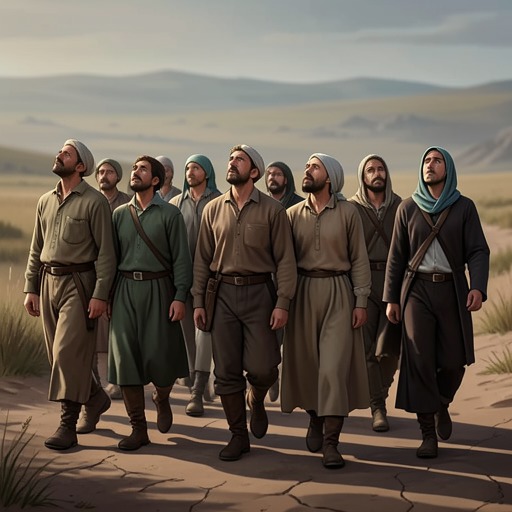
After Ayesha disappears and returns with a command for the villagers to walk to Mecca, the Titlipur panchayat votes to follow her. The pilgrimage is to be made on foot; the old and infirm are not to be carried in litters, while adults will take turns carrying the youngest infants. The villagers pool food and supplies, and Mishu prepares to leave with them. Saeed tries to forbid her, calling the venture suicidal, but she answers that he fails to understand what is happening because he has not looked beneath his European clothes toward his heart.
Mishu knows she is dying, yet she does not treat the pilgrimage as a substitute trip by car or a convenient journey to Mecca. When Saeed suggests that they fly there, she insists that the command is to walk with everyone else. His practical alternatives cannot reconcile his disbelief with the possibility that the journey might matter to her. As he breaks down, she embraces him and asks him to come. He agrees to go, though he continues to deny God. Her choice thus changes the marriage’s direction: Saeed follows not because his doubts have ended, but because he cannot bear to leave his dying wife alone.
The Road and the Sea
The pilgrimage proceeds at the pace of its slowest members, with sickness, official harassment, and delays slowing the party to roughly two miles a day. In the ninth week, the march attracts journalists, politicians, businesses seeking advertising, tourists, and religious extremists who dispute the pilgrims’ claim to the foot-pilgrimage tradition. The butterflies surrounding Ayesha draw public attention, while the movement becomes entangled in arguments over religion, national culture, and who may claim a public ritual.
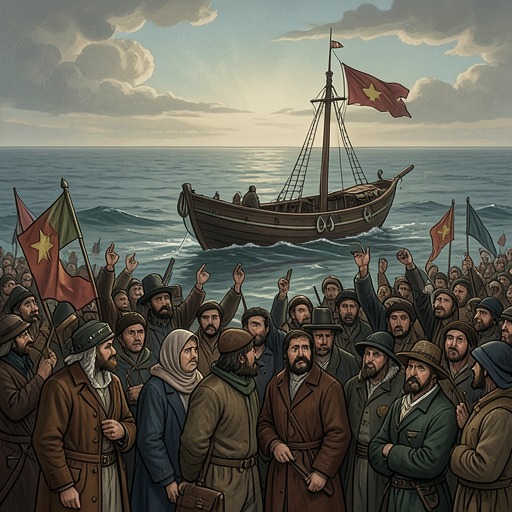
When the pilgrims reach the Arabian Sea, Mishu is so weakened that two villagers must support her. Saeed sees her beside Ayesha and imagines, briefly, that Ayesha has stepped out of his wife, as if Mishu’s brightness has taken the prophetess’s form. He then recoils from the thought, recognizing how far Ayesha’s supernatural claims have entered his own perceptions. The sea does not open as promised. Mishu, Ayesha, and the villagers walk forward and sink beneath the water; none is seen again. Saeed keeps diving farther out before he is rescued, exhausted and fainting. The pilgrimage ends, but Mishu’s fate is not explained beyond her disappearance.
Narrative Significance
Mishu’s story places intimate care beside competing accounts of truth. Her cancer is confirmed by doctors, while Ayesha’s prediction and promise of healing belong to visionary authority; neither the diagnosis nor the pilgrimage supplies a reassuring resolution. Mishu does not simply choose belief over medicine: she seeks a medical examination, learns its grave result, and then decides that the walk is still worth undertaking. Her action makes the pilgrimage personal without reducing it to a cure-seeking episode: it is also an act of solidarity with the villagers and a final shared journey with Saeed.
Her disappearance gives the novel’s promise of deliverance its starkest uncertainty. Saeed survives to face the authorities’ questions, but Mishu and the other pilgrims do not return. The narrative offers no confirmed account of whether the sea has swallowed them or whether the event fulfills Ayesha’s vision. Mishu’s ending therefore remains suspended between catastrophe and miracle, while her decision to walk stands as a deliberate act made in the knowledge that she is dying.